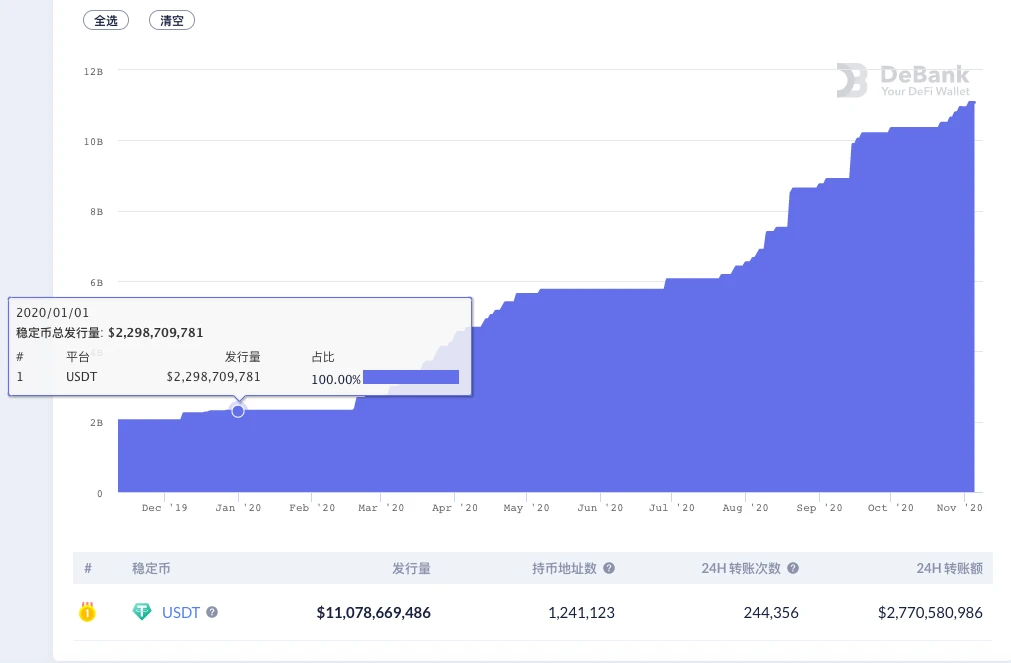
 As the first year of DeFi in 2020, a wave of DeFi came very suddenly and unexpectedly. Its tipping point was the launch of COMP governance tokens in June, followed by the currency issuance of domestic projects, and finally liquid mining pushed DeFi to The most enthusiastic peak is not only the DeFi boom, but stablecoins are also expanding their own markets. In the first year of DeFi, the leading stablecoin USDT alone has increased from the issuance of US$2 billion at the beginning of the year to the current year. How attractive is the issuance volume of 11 billion US dollars and the growth rate of 550%, not to mention the core DAI in the DeFi track, from the issuance of US$ 100 million to the current 900 million in just five months The issuance of US dollars directly occupies the third position in the stablecoin market. Although stablecoins are not the hotspot of this wave, they are the beneficiaries of every market advancement. (Data comes from DeBank)
Simple definition of stablecoin
A stable currency is a digital currency with a relatively stable market price, that is, the legal currency in the digital currency market. The background of its birth stems from the excessive volatility in the digital currency market, and a relatively stable digital currency is required to provide liquidity and Benchmarking other funds. At the same time, a currency in the virtual world is connected to assets in real life, and the first stable currency issued by USDT appears as a bridge connecting real assets and as a safe-haven product in the digital currency market to avoid the cold winter of the market. Huge outflow of funds.
The three core categories of stablecoins
Anchor legal tender
The stable currency anchored to legal currency is secured by legal currency and maintains a one-to-one ratio with legal currency. Traditionally, these stablecoins have tried to maintain a peg to the U.S. dollar, as well as other legal currencies such as the Euro, Japanese Yen, and gold, among which the U.S. dollar accounts for a large proportion. Representatives are USDT and TUSD, GUSD and PAX.
Decentralized asset mortgage
Cryptocurrency-backed stablecoins are secured by cryptocurrencies. Crypto-backed stablecoins and collateral do not maintain a one-to-one ratio, but instead link their prices to legal tender by maintaining a higher ratio of collateral to stablecoins. The collateral can be a single cryptocurrency or a basket of different cryptocurrencies, represented by DAI and BitUSD.
Algorithm Bank Support
The stablecoin supported by the algorithm has no collateral. These stablecoins try to maintain their legal pegs through a monetary policy similar to that of the central bank, represented by Basecoin and MakerDAO.
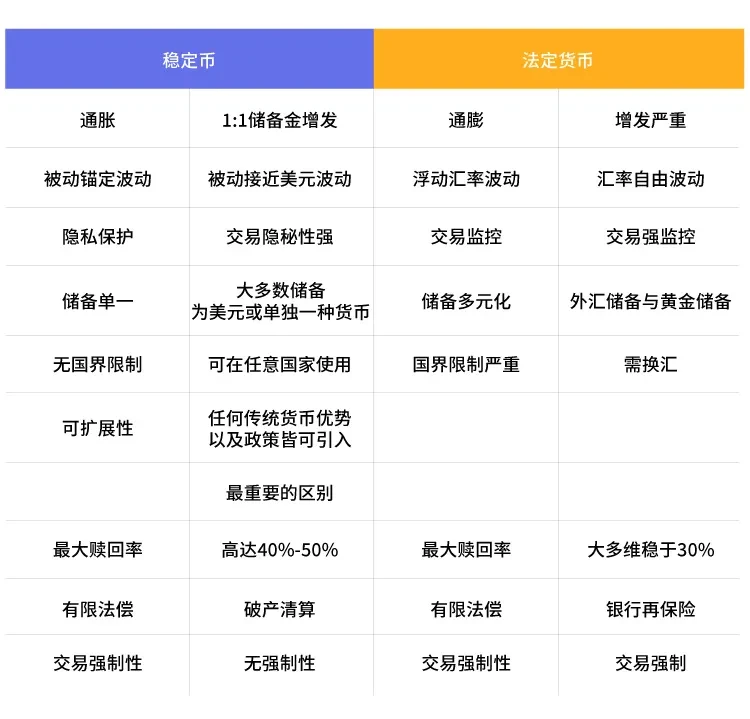
The difference between stable currency and fiat currency
The application of stablecoins in the current market
The most important aspect of stablecoins in the digital currency market is the role of trading media.
Transaction bridge and medium
As a bridge for legal currency to enter and exit the digital currency market, for most people, it is still an indispensable and most important part of converting their own legal currency into stable currency through the exchange’s legal currency C2C channel.
Act as a trading pair
At present, the most common trading pairs in major exchanges are still based on various stable currencies, such as USDT, USDC, and DAI. In addition, there are also trading pairs with mainstream currencies such as BTC, ETC, and ETH. Using stablecoins as trading pairs can clarify unilateral volatility, formulate trading plans in a simpler way and clarify market trends.
Safe haven currency in the digital currency market
For investors who do not intend to leave the market with digital currencies, when the future market expectations are not ideal, they can directly use stable currencies to arbitrage and hedge, or directly convert their currencies into stable currencies for hedging operations.
Why are various institutions launching stablecoins
Coinage
First, institutions seized the market to play enclosure games, and obtained the coinage rights obtained by countries in the real world relying on national credit, arms, and technology for many years, and the goal was directed at the core of the traditional financial field (bank).
Spread
Spread profit is simple and rude. The biggest profit point is the income generated by mortgaged dollars or other assets. The simplest is mortgage interest. The current total USDT issuance is 10.3 billion U.S. dollars. It is only a simple act regardless of other circumstances. The interest income from deposits in the bank is a very objective income. And this is only the income generated when USDT really anchors the U.S. dollar at 1:1 and does not reinvest any assets.
Is the stablecoin really stable (Impossible Triangle)
The “impossible triangle” means that a country cannot achieve the freedom of capital flow, the independence of monetary policy and the stability of exchange rates at the same time. In other words, a country can only have two of them, but not three at the same time. If a country wants to allow capital flows and requires an independent monetary policy, it will be difficult to maintain a stable exchange rate. If exchange rate stability and capital flow are required, independent monetary policy must be abandoned.
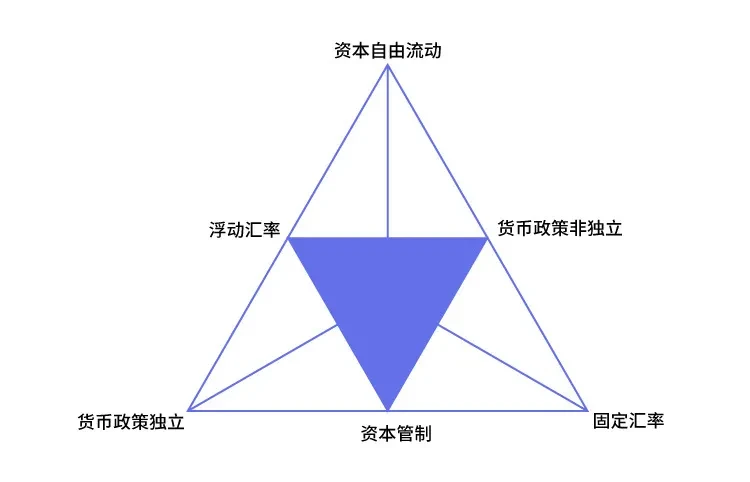 The solution to the largest stable currency USDT
The success of USDT is to completely abandon the independence of monetary policy and anchor the exchange rate and reserves to the value of the U.S. dollar, gaining strong liquidity and stability of the U.S. dollar, but if USDT is not anchored to the U.S. dollar, it will lose the market. The degree of trust, that is, the core stability of stablecoins has been lost.
The solution of the most concerned stablecoin DAI
The success of DAI gains market trust through multi-guaranteed non-national centralized currencies and stays away from monetary politics. Through algorithmic banking, the price of DAI is softly pegged to the U.S. dollar to obtain a fixed exchange rate, and higher capital liquidity is obtained through the previous DeFi boom. However, it has not experienced significant redemption in the market, and most of its reserve funds are highly volatile currencies. It still takes time to test whether it can complete the 1:1 exchange with the US dollar when the market fluctuates sharply.
From the perspective of market applications
At present, the stablecoins in the market can be divided into three categories by issuing institutions and application scenarios. The first is stablecoins issued by centralized institutions, led by USDT, USDC, and PAX, and the second is stable currency issued by centralized exchanges. Coins, represented by Huobi HUSD, Binance BUSD, USDK, etc., and the third type is a stable currency issued by decentralized financial DeFi with an anchor mechanism, represented by Dai, USDX, etc. The three types are different due to their origins. , The application scenarios and directions are already different.
Stable coins issued by centralized institutions and centralized exchanges
The market application is relatively similar, relying on the exchange’s huge asset entry development, and playing an important role in the exchange’s ecology as a trading pair and safe-haven currency (trading medium and stored value). The goal of the stable currency issued by the exchange is to use its own exchange The advantage of the party is to grab the stable currency market occupied by USDT and use its own stable currency to exchange with other currencies. On the one hand, it is convenient for customers to deposit and withdraw money, deposit and withdrawal operations, and on the other hand, it can divert the stable currency issued by itself to occupy the market.
The stablecoins issued by centralized institutions take strict financial audits as their own advantages. However, the repeated over-issuance of USDT and the suspected manipulation of the BTC market have caused the stablecoin mechanism of centralized institutions to be questioned by the outside world.
Stable currency under decentralized financial DeFi
MakerDAO (Dai)
It is a DeFi project built on Ethereum that allows holders of cryptocurrencies to apply for over-collateralized loans. These loans are paid in the form of DAI. DAI is a decentralized stable currency that is leveraged by monetary policy and has a value of 1 USD Linked, users can generate DAI by depositing the cryptocurrency received in the protocol.
From the perspective of users, MakerDAO pledges users’ digital assets ETH through smart contracts, and then lends users the same amount of stablecoin Dai for free use.
The biggest difference from the stablecoins issued by centralized institutions is that the overall operating mechanism of Dai is completely open and transparent. Not only is Dai itself transparent, but the amount of ETH exchanged for Dai is also transparent and visible to the outside world. More importantly, Dai is always over-collateralized to take advantage of risks. The protection and arbitrage clearing mechanism deducts the collateral, so that Dai always has sufficient asset guarantees, so that Dai always has sufficient redemption regardless of market fluctuations.
However, because Dai is a DeFi project built on Ethereum, only ETH of ERC20 has enough circulation for applications to be used as collateral. The overall market scope is limited, resulting in the total issuance of DAI never exceeding the $1 billion mark.
Kave (USDX)
It is a multi-asset DeFi platform based on the Cosmos ecology. At the same time, Kava is a separate public chain. This is very different from Ethereum-based Maker. The unique cross-chain features of Cosmos make it easier to implement public chains in the same ecosystem. Cross-chain interoperability.
USDX adopts an elastic supply mechanism. Under normal circumstances, the supply of USDX is linked to the value of mortgage assets and the mortgage rate, but if there is a liquidation or debt auction, the system will expand the supply of USDX accordingly to achieve a balance of over-collateralization.
The most important advantage of Kave over Maker is that DAI can only be generated by ETH mortgage. When the price of Ethereum decreases, the supply of DAI will be reduced, subject to strong market limitations. Kave’s logic can be mortgaged through USDC, PAX, DAI When USDX is generated, at the same time, USDX can be exchanged into other stable currencies by mind, which greatly increases the liquidity of the hurdle market.
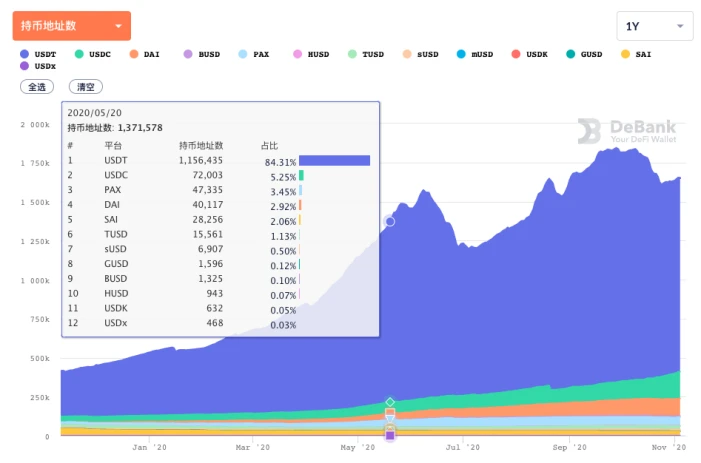
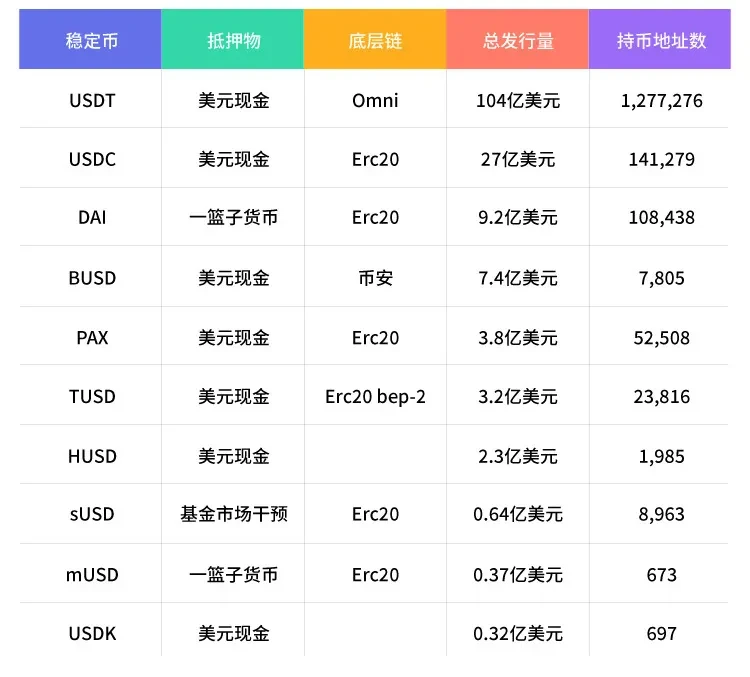
The following is the current market data of the top ten stable coins:
Stable coins still need stability as the top priority
For stablecoins, maintaining price stability is the most important, but to ensure price stability, it is necessary to maintain a low-friction recovery and issuance mechanism, capital utilization, and sufficient market convenience. The reason why USDT has already occupied two-thirds of the market under continuous thunderstorms is the adaptability of the market and the convenience of exchange. DAI is due to the market limitations of Ethereum and the high gas fee. Limited growth space. To gain a place in the stablecoin market robbed by major institutions, the following points still need attention.
Issuance and recycling with sufficiently low friction
That is, to reduce the difficulty of asset transactions, and to reduce the friction of issuance is to make it easier for market participants to redeem the diversified assets into the issued stable currency, as well as enough trading channels and OTC channels, while reducing the difficulty of recovery is So that market participants can simply exchange the issued stablecoins for other assets they need to invest in directly.
Increase fund utilization (mortgage rate)
The fund mortgage rate is a unique point of stablecoins under DeFi. Based on the decline in fund utilization rate caused by the over-collateralization model, although liquidity mining uses a high rate of return in a short time to make up for the problem of insufficient fund utilization, the overall The over-collateralization rate as high as 120%-150% limits the development of the market and reduces the attractiveness of the lending model to users. DeFi-based stablecoins still need to learn from traditional financial credit models, and effectively increasing the utilization rate of funds will have more benefits that can be allocated to market users.
Sufficient application scenarios
- Fund payment and offline payment
The price of stable currency is relatively stable, and it can replace the current electronic currency payment method to a certain extent. As the hard currency of fund payment, it is the landing application method of electronic currency issued by various countries based on legal currency. At present, stable currency has the biggest prospect in fund payment. That is, salary payment, commodity purchase, cross-border payment and other methods.
- Cross-border payments and block transactions
Economic globalization has made cross-border payments extremely common, but for legal currencies, foreign exchange security is considered. Cross-border payments require more cumbersome procedures and need to wait for the approval of centralized institutions, while stable currency cross-border only needs to be Point-to-point address transfer, the other party can complete the transfer and payment process by realizing off-exchange or transaction. Compared with traditional cross-border transfer methods, it has a strong efficiency advantage, but the relative balance of fund security (black production, money laundering), payment efficiency and privacy is a greater market prospect.